Inside the playbook of a career interim CFO, lessons from nearly 90 companies and 18 years in the seat.
AUTHOR

Brian Lafer
Managing Director
Head of the TrueBridge Practice
IN CONVERSATION WITH

John McCarthy
Interim CFO
.
Introduction
There’s a stubborn assumption in the market that interim executives are simply talented people between permanent jobs. I hear it constantly, from investors, boards, and sometimes from CFOs themselves. It has never been less true than it is right now.
John McCarthy is proof. After roughly 15 years in traditional finance roles, first at large companies, then at venture and private equity backed businesses, John has spent the last 18 years as an interim or fractional CFO to nearly 90 companies, from Seed stage through Series C and beyond. He earns significantly more than he would as a full time CFO. Nearly every company he’s worked with has tried to hire him permanently. He’s said no to almost all of them, by design.
I sat down with John and asked him the questions our clients and candidates ask us most. This paper distills that conversation for three audiences:
- The VC and PE partners who hire interim leaders
- The CEOs and boards weighing the model for the first time
- The finance executives wondering if this path could be theirs
A career interim CFO isn’t a permanent executive in transition. It’s a distinct professional identity, a deliberate business model, and in John’s case, an 18-year track record of compounding success across industries, geographies, and company stages.
Why do high-performing finance executives choose the interim path?
John didn’t drift into interim work. He chose it, for two reasons that come up again and again with the strongest executives in our network: variety and portfolio economics.
After a decade as a CFO or VP of Finance inside single VC- and PE-backed companies, he realized the traditional track wasn’t giving him what he valued most:
“I really valued having a lot of variety in my career. I wasn’t getting that from working for a single company for years at a time.”
The financial logic followed close behind. The same portfolio-thinking investors apply to capital, applies just as well to a career:
“If you’re working for one company for five years, you get maybe five or six shots at a big equity payday over your whole career. Spread yourself across multiple companies and your exposure to opportunity grows dramatically.”
How does a top interim CFO handle the “just between jobs” stigma?
John’s most effective move is addressing the stigma before anyone else can raise it. In every first meeting with a CEO, founder, or investor, he sets the terms plainly. He isn’t auditioning for a permanent seat, and he isn’t the right fit for a temp-to-perm arrangement:
“This is my full-time gig. I’m a full-time fractional interim CFO.”
He frames the exit just as clearly on day one:
“When the company needs someone other than me in the seat, I’ll make it easy. Zero drama. I’ll help you find the next person.”
That promise reframes the whole engagement. The client isn’t hiring someone who might leave. They’re hiring someone whose plan is to leave well.
The market has tested his resolve. Across nearly 90 companies, almost every client has tried to convert him to full-time. Only one or two ever tempted him, and neither worked out. His explanation gets at what top interim executives actually are:
“My skills are built to fix things and put structure in place, not to run them long term. I find a problem, fix it, and move on when the time is right for that particular company.”
What does an interim CFO do for the permanent hire who comes next?
One of the least appreciated benefits of the interim model is what it does for the next hire. John is often brought into companies with no financial structure, or structure gone bad. By the time he leaves, the company understands its financials and its unit economics, and stands on stable footing.
“The next person doesn’t have to spend six to nine months figuring out what happened before them. I’ve already gotten the company to a point where they can take off.”
For talent partners, this is the quiet compounding value of a strong interim leader. The permanent search gets easier, the role gets more attractive to candidates, and the incoming executive’s first year gets far more productive.
John applies the same clean-break discipline when he’s the one arriving. When companies offer to keep a departing CFO around for a few months to smooth the transition, he declines:
“Having that person hang around just confuses the team and sends mixed signals. Give me a few key details and where the passwords are. We’ll figure out the rest.”
Is the financial upside of interim work real, or just a well-kept secret?
For John, it’s a deliberately structured trade, not a secret. His cash compensation runs significantly higher than a full-time CFO would earn at the same companies. What he gives up is upfront equity, and he gives it up on purpose.
The logic runs both ways. Walking in the door, he can’t accurately value the company’s equity, and the company can’t yet know if he’s worth granting it to. Six months in, both sides can price the relationship honestly. Equity has followed on his longer engagements, though he’s quick to note every situation plays out differently and walking in with fixed expectations is a mistake.
That same discipline shows up when he handles sticker shock, a conversation we have with clients at TrueBridge every week. When a CEO objects to his rate, John walks them through the alternative. A full-time CFO at a venture-backed company typically earns 1 to 1.5 percent equity, worth $3 to $4 million by the CEO’s own estimate, plus $350,000 to $400,000 in cash. Spread over a four-year vest, that could be well over a million dollars a year in total compensation. John’s pitch: comparable work in cash only, at a fraction of the cost with no dilution.
“I know how to value a dollar of cash. Valuing startup equity is largely a guess.”
How does an interim CFO walk into a crisis on day one?
There’s no 90-day plan for an interim executive. The clock starts the moment they walk in.
“I know what needs to be perfect and what doesn’t. The things that don’t need to be perfect, I get 90 percent right. The things that need to be perfect, I get as close to 100 percent as you can get.”
More junior operators, he’s found, treat everything as equally urgent and burn hours polishing details that don’t matter yet for the company’s stage.
John’s approach to a stressed, panicked CEO begins with refusing to absorb the panic himself:
“You show them, through your words and your actions, that you’ve seen this before, fixed it before, and it’s going to be okay.”
Believing everything a team with its hair on fire tells you, he says, is a recipe for disaster. Instead, look at the numbers, look at the model, talk to people, and start pattern-matching.
Sometimes the situation really is dire. One CEO once called to say he wasn’t sure the company would make payroll that week. John’s answer: he’d be there right away. They worked through the numbers, the bank, and the people involved, until the panic separated from reality:
“We got the facts on the table, instead of the fear and the conjecture that had been swirling around.”
This is also where the outsider advantage shows up. People who caused a problem, whether through bad accounting or bad practices, are often the worst positioned to fix it, because reputation and self-protection cloud every decision:
“You need somebody from the outside who’s impartial, who can get you to a solution that isn’t tied to how the problem started.”
What’s the reality of fractional work: Freedom or twelve bosses?
John is candid that the popular image of fractional work, total control over when and how you work, is a myth, at least in finance:
“At any point in time, I’ve got eight to twelve CEOs who know that if they call, I’ll pick up and talk right then.”
The real trade looks different. He isn’t tied to any one place, but he commits to being extremely available to everyone. When a client calls with a problem, John strives to respond with an answer or a plan immediately, or within two hours.
That’s why he pushes back on the tidy idea of assigning each client a fixed day of the week:
“That doesn’t work, especially in finance. Fire drills show up constantly, and you need to be there at a moment’s notice. Lifestyle isn’t a good reason to do this. For me, it’s the new challenges, all the time.”
His practice reflects that discipline. At any given time, two anchor clients typically make up about half his monthly income, with eight or so more filling out the rest, all on staggered timelines. He commits certain days, a few hours at a time, to individual clients, but he won’t take on a four-to-five-day-a-week engagement that would force him to drop existing ones.
For companies that genuinely need someone in the seat that many days a week — a common profile among our clients — calls for a different kind of interim executive. Matching the model to the need is part of TrueBridge’s job.
What drives John isn’t the freedom, it’s the adrenaline:
“New problems, new boards, new management dynamics, new industries, all the time. That’s what I enjoy.”
What’s the biggest misconception CEOs have about interim CFOs?
John doesn’t hesitate to answer: it’s the assumption that the role is bookkeeping with a better title. Success starts with building a strong relationship with the CEO early and making clear the CFO isn’t a glorified accountant.
The real job is directional:
“The CFO’s role is to make sure the company is moving in the right direction and not deluding itself on where its actions are taking it.”
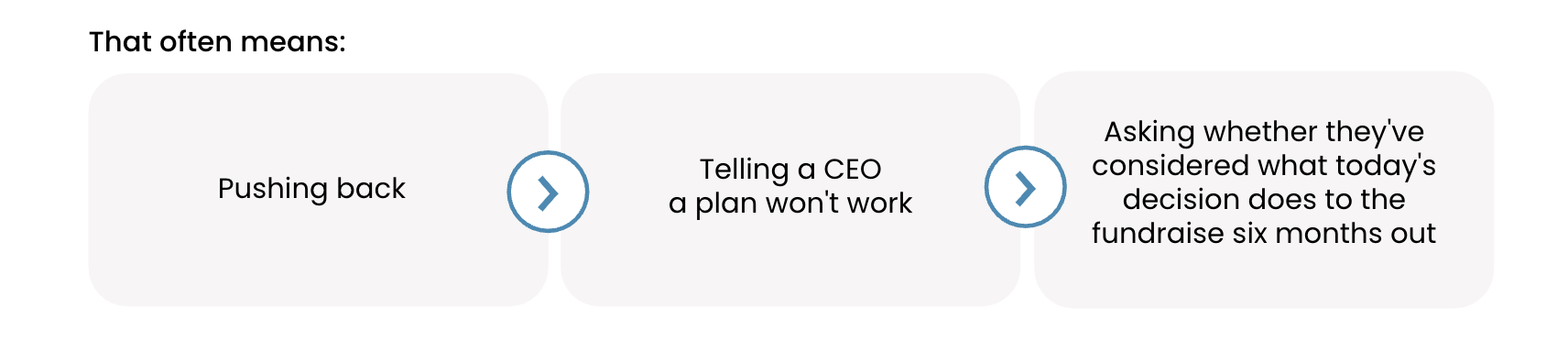
Some executives simply validate whatever the CEO wants to hear. John isn’t one of them, and he says so before he’s hired:
“If you want a yes man, it’s not going to be me.”
Is fractional work the future or a niche?
When I ask where the market goes over the next 10 to 20 years, John doesn’t hedge:
“Without a doubt, the future of work is fractional.”
His reasoning comes from four decades in finance:

Underneath the prediction is a deeper claim about what companies will value in their leaders:
“Someone who’s seen lots of different situations brings more value than someone who only knows one industry inside and out, because everything is changing too fast. Pattern recognition matters more than longevity in a role.”
What should a finance executive ask before going interim?
For the talented but burnt out permanent CFO hesitant to make the leap, John offers one diagnostic question:
“If you took a six-month contract and they offered you the full-time role afterward, would you take it?”
There’s no wrong answer, but you need to know yours.
“Know your motivations. If the answer is yes, take assignments that could get you there. If the answer is no, build your network and use a partner like TrueBridge as a springboard into this way of working.”
That distinction matters on the client side too. At TrueBridge, we explicitly assess whether an interim candidate genuinely wants the interim assignment, or is quietly auditioning for the permanent job at the expense of the short-term priorities they were actually hired to solve. Both paths are legitimate. Confusing them is where engagements go wrong.
On the fear that stops most would-be interims — the worry about where the next project comes from — John’s own history is instructive:
“I can trace 70 to 80 percent of my work over 18 years back to that first investor and that first company, and everything that grew out of those relationships.”
Luck and timing matter, he says, but so do reputation and simply letting people know you’re available. There’s no single path. Your network and your reputation carry the practice long term.
This is where a partner changes the math:
“TrueBridge gets you in front of the people thinking about hiring interim talent, the boards and companies that already do this. It’s been a great way to jumpstart the work, and over time, to grow my own network.”
The practical effect, in John’s experience, is focus.

What’s next for John, and for the interim CFO market?
After nearly 90 companies, John’s ambition for the next decade isn’t more of the same. It’s multiplication through coaching:
“Lately, a big part of what I do is to help junior finance people move into the VP of Finance or CFO seat. That’s where I see myself going for the next five to ten years.”
It’s a fitting next chapter for someone who built a career on clean exits, strong handoffs, and now, on passing along the pattern recognition itself.
A closing note from TrueBridge
Conversations like this one are why we built TrueBridge. The interim and fractional model isn’t a consolation prize or a bridge between jobs. For executives like John, it’s the job, and for the companies that engage them, it’s often the fastest route from crisis to stable footing and a stronger permanent hire. The market is moving toward this model. The stigma just hasn’t caught up yet.
If you’re an investor or operator weighing an interim leader, or a finance executive weighing the leap, we’d welcome the conversation.
Continue the Conversation